
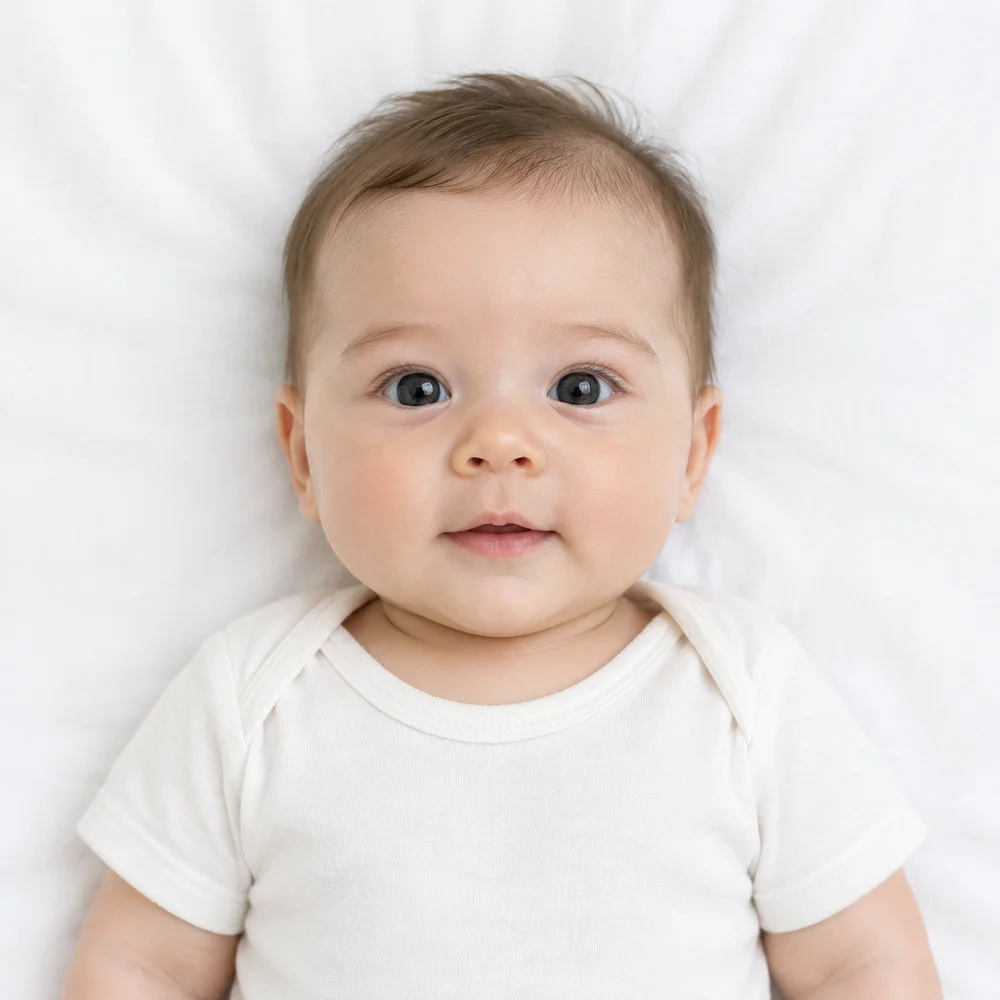
Taking a passport photo for a baby is genuinely tricky — infants can't follow instructions, and the rules still require a recognizable, compliant photo. This guide covers every official requirement for baby and infant passport photos, plus two reliable methods you can do at home without any studio equipment.
Official rules still come from the State Department’s Passport Photos page (same 2×2 size and background rules as adults, with practical leniency for very young infants). Context: Passport photograph (Wikipedia).
Need to make the photo compliant once you have a good shot? Upload in the Just ID Photo maker, select US Passport (2×2), and preview the crop for free before you pay.
Baby Passport Photo Requirements at a Glance
The same US Department of State rules apply to babies as to adults — with a few practical allowances for infants who can't hold a pose:
| Rule | Adult | Baby / Infant |
|---|---|---|
| Photo size | 2×2 in (51×51 mm) | Same |
| Background | Plain white or off-white | Same |
| Color | Full color | Same |
| Recency | Within last 6 months | Same |
| Eyes | Open, looking at camera | Preferred; leniency for newborns |
| Expression | Neutral / natural smile | Neutral; slight variations accepted |
| Mouth | Closed or slightly open | Same |
| Support in frame | N/A | No hands, arms, or supports visible |
| Props | None | No pacifiers, toys, or blankets in frame |
| Head covering | Religious only | Same |
| Car seat / stroller | N/A | Must not be visible |
The key differences: no hands or arms supporting the baby may show in the photo, no pacifiers, and no car seat hardware visible. Beyond that, the standard rules apply.
Do Babies Really Need Their Own Passport?
Yes. Every US citizen — including newborns — needs their own passport to travel internationally. Children cannot be added to a parent's passport. Each child needs their own application (Form DS-11) and their own photo.
Passport photos for children under 16 follow the same rules, but there are no waivers for age — even a 2-week-old needs a valid photo.
Method 1: White Sheet on the Floor (Best for Newborns)
This is the most reliable method for very young babies who cannot support their own head.
What you need:
- A plain white or off-white bedsheet (no patterns, no texture visible in photos)
- A phone with the rear camera
- Natural daylight from a window or two soft lamps
Steps:
-
Lay the sheet flat on a clean floor or firm surface. Smooth out all wrinkles — even light creases cast shadows that can make the background look non-white.
-
Place the baby on their back in the center of the sheet. Their head should be near the center, face pointing directly upward.
-
Position yourself directly above the baby, phone pointing straight down so the lens is parallel to the baby's face. This gives the flattest, most shadow-free result.
-
Check the frame: The photo should show only the baby's face and white background. No hands, arms, blanket edges, or floor should be visible in the final square crop.
-
Lighting: Open a nearby window or point two lamps from the side (not from directly above, which creates harsh shadows on the face). Avoid direct sunlight, which is too harsh.
-
Take multiple shots — babies move, blink, and look away. Take 15–20 photos in a session and select the best one.
What to look for in the best shot:
- Both eyes open (or partially open — acceptable for newborns)
- Face visible and unobstructed
- No hands in frame
- Background uniformly white behind the head
Method 2: Car Seat with a White Sheet Cover
This works better for babies who can support their head (typically 3+ months) or if the floor method is difficult.
Steps:
-
Cover the car seat completely with a plain white or off-white sheet. The sheet must cover all colored parts — the seat shell, harness straps, and buckle — so nothing colored shows in the photo background or beside the baby.
-
Check that the harness straps are hidden across the chest and over the shoulders. This is the most common mistake — a colored strap across a shoulder causes rejection.
-
Place the baby in the covered seat and position the seat on a flat surface.
-
Photograph from the front at eye level — hold the camera at the baby's eye level and photograph straight ahead, not from above.
-
Check the frame for any visible colored parts of the seat, straps, or clips.
The 5 Most Common Rejection Reasons for Baby Photos
| Rejection cause | How to avoid it |
|---|---|
| Supporting hand or arm visible | Use the floor method; have the hand completely outside the crop area |
| Pacifier in mouth | Remove all pacifiers before taking the photo |
| Car seat hardware visible | Cover the entire seat with a white sheet, including straps |
| Background shadow | Smooth the sheet flat; use side lighting, not overhead only |
| Sheet wrinkle creates grey tones | Iron or stretch the sheet tightly on a flat surface |
Eyes Open — How Strict Is the Rule?
The US State Department's guidance says both eyes must be open and clearly visible. However, they also acknowledge that very young infants cannot reliably keep their eyes open, and passport acceptance officers typically allow some flexibility for newborns.
Practical guidance:
- Newborns (0–3 months): Partially open eyes or eyes in a natural blink position are often accepted
- Infants (3–12 months): Eyes should ideally be open and visible
- Toddlers (12+ months): Both eyes fully open is expected
If the baby's eyes are partially open but the face is clearly visible, the photo is usually fine in practice. Aim for open eyes, but don't stress if you get a photo where eyes are not fully wide open.
Timing: When to Take the Photo
Best times:
- Shortly after feeding when the baby is calm
- Mid-morning or mid-afternoon when natural light is good
- During a natural awake period (not when fighting sleep)
Avoid:
- When the baby is hungry or overtired
- Right after feeding if the baby is fussy
- Harsh midday direct sunlight (through windows)
Budget 20–30 minutes for the session and take many shots. You only need one good one.
Phone Camera Tips for Baby Photos
- Use the rear camera (higher resolution than the selfie camera)
- Turn off Portrait Mode — the blurred edges and skin smoothing cause rejections
- Disable beauty or smooth filters
- Use burst mode or rapid tapping to capture open-eye moments
- Keep the phone steady — motion blur is a common issue
- If possible, have a second person gently attract the baby's attention toward the camera while you shoot
Uploading and Cropping
Once you have a good shot, upload it to Just ID Photo and select US Passport (2×2). The tool crops to the correct 51×51 mm dimensions and processes the background. Preview is free — you only pay when you're happy with the result.
The output includes:
- A clean 2×2 digital JPEG for online applications
- A multi-copy 4×6 print layout for mail-in applications or home printing
Frequently Asked Questions
Does my newborn really need a passport photo?
Yes. There are no age exemptions. Even a newborn needs a valid passport to travel internationally, and every passport requires a photo. The practical flexibility for infants is in pose and eye position, not in waiving the photo requirement.
Can I take the photo myself or do I need a professional?
You can take it yourself. The US State Department does not require a professional photographer for passport photos. The photo just needs to meet the technical requirements (correct crop, white background, etc.).
My baby's eyes won't stay open. Will it be rejected?
For very young infants, passport acceptance officers understand that eyes may not be fully open. A photo where the baby's eyes are partially open but the face is clearly visible is generally accepted. Aim for the best open-eye shot you can get, then submit it.
Can I use a car seat for the photo?
Yes, if the entire seat and all straps are covered with a plain white sheet. No colored parts of the seat or harness should be visible in the photo.
How do I keep my baby still for the photo?
Take many shots in rapid succession and pick the best frame. Feed the baby first, work during a calm awake period, and have a second person attract the baby's gaze toward the camera. Burst mode on your phone helps capture the right moment.
Can the baby be wrapped in a white blanket?
The baby's face must be clearly visible with nothing obscuring it. A plain white blanket that is completely flat and shows only as background is technically fine, but any folds, ridges, or texture in the blanket can be visible in the photo. The sheet method is more reliable.
How many passport photos does a baby need?
- New passport (DS-11): 1 photo submitted with the application
- Some applications or offices may request 2 identical photos — check your specific form
How recent does the baby's passport photo need to be?
The same as adults: taken within the last 6 months. For a baby, this is especially important because infants change quickly — a 3-month-old looks noticeably different from a 9-month-old.
Related Guides
- US passport photo requirements (complete checklist)
- US passport photo size (2×2 inches)
- Passport photo white background requirements
- Passport & ID photo sizes chart (mm)
- How to print passport photos at home on 4×6
- Make ID Photo · Photo Sheet Maker